
Elena Marchenko + Yuri Endo 2011
31 October 2011

RGBDemo with minimum camera movements


Elena Marchenko + Yuri Endo 2011
We re-tested 3D scanning with minimum camera movements. Compared to our previous test scanning with continuous movements, we were able to scan clearer images during the second try-out.
25 October 2011


18 October 2011
Mirror Test


Yuri Endo 2011
As suggested, I placed a mirror in front of Kinect to see if it really does capture reflections. (Reflections from>> Upper: a bathroom mirror, Lower: a handheld mirror) Next step is to find a parabolic reflector to place in front so we can achieve wide angle view from kinect.
16 October 2011
15 October 2011


10 October 2011

05 October 2011
Running with Marchenko
Elena Marchenko + Yuri Endo 2011
*CocoaKinect>>Point Cloud>>Normal
I clearly understood why most of the steadicam operators are well-build male with unapproachable air. The pratice videos which my fellow project mate, Elena Marchenko, and I worked on today ( I was the camera operator) looks exactly like a amateur girl's job. Serious training is a must to operate this monster correctly.
04 October 2011
Steadicam test

Elena Marchenko + Yuri Endo 2011
*Elena Marchenko trying out the steadicam
During today's calss, we mounted Kinect on steadicam for a test shoot. Although the equipment felt extremely heavy at first ( approximately 10kg) , when I started moving around, it became slightly lighter and manageable.
03 October 2011
Kinect+Laptop without an AC adapter?
Thanks to Professor D.H., I discovered some examples of Kinect power hack techniques which might clear out my power related concerns. Frankly, I am still in the process of understanding what is actually going on throughout this video and further research is absolutely needed before I wreck my laptop and Kinect. Stay tuned.
Fear and loathing on Hannam Bridge
Since I voluntarily crossed this bridge last summer, I have been seeking a visionary approach to document that exceedingly fearful experience. A few days ago, I attempted to reanimate the event and ended up backing off at the very tip of the bridge due to the strong wind. This time I have finally succeeded in reaching the mid point and capturing the glimpse of the feel.
Although, the bridge crossing experience may seem to be rather dull from this test video (mostly owing to my walking speed with a handheld camera on the shaky bridge.), it is unquestionably a slightest nerve wrecking activity. Hence, I am even more interested in recapturing its visual impact through the Kinect vision.
For the final movie, I plan to complete crossing the entire bridge, preferably not during peak hours where there are more supersonic speed drivers, to enhance both phycological and physical effects that the Kinect imagery may give out to the viewers.
What happened at the Kim's
While I'm simultaneously figuring out the power source solutions, I decided to go on location and shopping cart huntings for the potentials themes, especially for Theme One and Five, both of which I did not chose as locations during the production of my previous Z-depth and Movement project.
The above test was shot in the morning of a Korean national holiday at a large scale local supermarket, Kim's Club, located in 고속터미널 (Express Bus Terminal). My DSLR was placed on a tripot inside of a shopping cart. Initially, I was expecting people to give me a hard time shooting there, surprisingly no one cared or even noticed which made this location an A+.
Unfortunately, the shopping cart couldn't make it home with me.
02 October 2011
Possible locations
Theme One >>Bridge<<

Theme Two >>Public transportation<<


Theme Three >>Night vision<<


Theme Four >>Local scene<<


In addition to the themes that I had chosen for my past project, I have included two fresh locations on the list; Theme One: Bridge and Five: Supermarket
Alternative Z-mobile

It just came across my mind; in stead of inventing a Z-mobile myself, what if I purchased one of those which may be able to achieve something closer to what I have been desiring for? I still have to test how swiftly and stably this mini vehicle can be operated when a person on board with a laptop, kinect and possibly a power source. Nevertheless, it seems to come incredibly in handy when I need to proceed "nonchalant" film shootings in public spaces.
Looking for Mr. Goodpower

I have been seeking for Mr. Good; lightweight portable battery chargers and battery, to connect my kinect and laptop for outdoors/long distance uses.
Unfortunately all I could find up until 2 days ago were gigantic devices which were definitely not designed to be moved around to say the least. Considering myself not too much of an athlete, I wouldn't be able to even carry them around by myself, let alone testing it out "casually" in public spaces.
Today, I think I might have found a "lighter" solution thanks to Monsieur J.C. Naour. According to J.C., Kinect and laptop can be connected to DC inverter + 12V deep cycle battery which is smaller than a shoebox ( what a great description!) and can be highly portable. I'm off to the hunting.
26 September 2011
Kinect + Synapse

Yuri Endo 2011
*LEFT: After striking the "psi" pose for several seconds, you get a image of skeleton binded to yourself. RIGHT: The image you get from running Kinect test.qtz in the downloaded package.
Kinect can be also connected to Mac OSX via Synapse. Unlike cocoaKinect, this open source application seems as though there are no tilting functions, however, it allows us to use Kinect to control Ableton Live and Quartz Composer, among many others to add more visual and sound effects.
25 September 2011

Market research

Yuri Endo 2011
Since my previous Z-mobiles (Z-trolley 001, Z-trolley 002) were such amateur jobs, I would like to create more sophisticated and esthetic trolley this time. Above images are some design inspirations that I browsed at Dongdaemun Market in Seoul.
19 September 2011
Z-nect + Munny Test video
The test result indicated that Kinect needs at least 10 ㎝ distance to capture objects ahead of it. As the camera came closer to the object (approximately 15-10 ㎝ ahead) it showed color change and created an interesting imagery. Testing on the maximum distance would be my next mission as I only could test up to 3m this time due to my room size.
When Z-nect met Munnies

Yuri Endo 2011
To get a general idea of how a Z-nect imagery look like, I tied Kinect to an unused metal luggage carrier which I initially purchased for my previous Z-depth and Motion project, and captured 2 Munny dolls on my room floor.
17 September 2011
Don't be afraid of the dark

Yuri Endo 2011
I set cocoaKinect as in the image above and checked how the image look like with and without room lights. It goes without saying, the results looked exactly the same since it's an infrared camera, which proved that it is surely suitable for night shots.
10 September 2011
Z-nect (Z-depth+Kinect) agenda
Highly inspirational project, Hyper(reality) by Maxence Parache
Maxence Parache, a recent graduate of the MA at Central Saint Martins created an augmented reality helmet working with Kinect which allows the user to change his/her point of view of space and navigate through the 3D environment. His video experimentations show clear ideas of hyperreal vision that the user sees while he/she physically interact with the real environment; in public spaces such as museums and stores.
While his experimentations are largely focused on the user experience; human behavior when they constrained by technology and how it influence their life and social interaction, I would like to put more weight on the easthetics of the actual hyperreal visions that can be achieved from Kinect camera and if possible, other devices such as Arduino to enhance the visual effects, then connect these experimentations to explore new possibilities in the motion pictures and video art. In that sense, my tasks for next few weeks would be;
1. Experimentations in public spaces and evaluation of locations:
Experiment how the Z-depth movements can be seen through Kinect at day and night, open and closed settings.
2. Scenario development:
Considering a Kinect is cut out for capturing imageries within 10m distance, my challenge is to develop possible scenarios "compactly".
3. Exploring more Kinect hacking options:
My Kinect is currently operating via CocoaKinect. Although it's going to be a great challenge, I probably need to experiment with Openframeworks and Processing to capture much sophisticated imageries.
4. Z mobile invention:
Search and evaluate much accurate and aesthetically pleasing ways for Z tracking.
04 September 2011
It's business time
A short experimental movie, The Zbender, was completed as my final project for the course, Media Environment Unit One, in which I was given an opportunity to experiment with the concept of the Z and zdepth intergrading with stereophonic 3D effect. During the course of this project, I took advantages of my knowledge and skills from my previous specialization in the film production along with my 2-year education in design.
Through out the course of Media Art Unit Two and ongoing "Green Growth" research project, one of my new challenges is to expand what I have learned from this project utilizing Kinect and other devices.
28 June 2011
Mission likely possible

Yuri Endo 2011
*Project mates, HeeSoo Moon and Jihyeon Kim
In this session, we have brainstormed the primary objects of our 3 possible areas of research:
1. Z-depth moving image and interaction
2. Fashion and telephone interaction
3. Adult entertainment and physical interaction
The details of each subjects to be further developed. On that note, I have been assigned to participate in the Z-depth projects. Aside from theoretical and physical Kinect experimentations, my momental missions would be; the exploration of its artistic motifs and investigation on feasible outputs in the fields of film and publication.
25 June 2011
A note from the lab bench
Upon researching existing Kinect experiments, I have encountered two inspiring ongoing works which explore 3D fragments of time and space as well as new form of musical performance.
Considering my background in the film production, my main concentration for this research project could be exploring the interaction between Kinect and moving image to enhance cinematic experience in the field of interaction design. In that sense, its particular needs to be further evaluated following additional explorations on related subjects.
24 June 2011
Fabulous cocoaKinect
Yuri Endo 2011
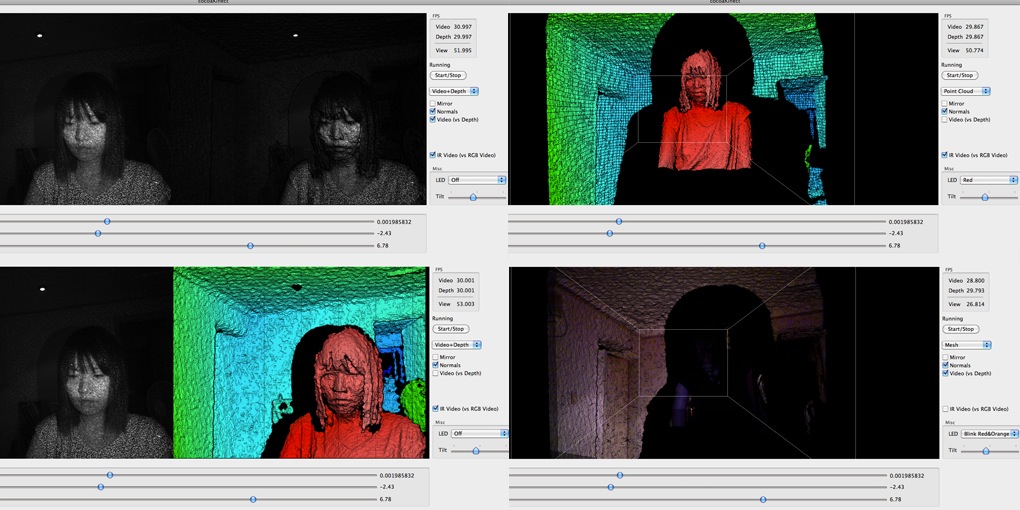
*First Kinect test run on Mac OSX (10.6.7)
Kinect can be easily connected to Mac OSX via cocoaKinect. This fabulous open source application enables us to connect Kinect with Mac without any additional libraries or coding, and more importantly, it does work like a charm.
23 June 2011
Battlestar Kinectica

Yuri Endo 2011
*The latest partner in crime purchased at 137,600 KRW online
Introducing Kinect, with which we will be experimenting for our forthcoming projects.
22 June 2011
Kinect workshop by Jean-christophe Naour
Kinect Graffiti™ by Jean-christophe Naour
Jean-Christophe Naour, a Seoul based Interaction designer, came in to give us a short introduction to Kinect with which we will be exploring its possibilities and new forms of interaction design this summer. He is currently working on Kinect Graffiti Tool which utilize Kinect to track the motion graffiti. The workshop was highly informative on the whole, his works and experiences were likewise inspiring.
Reference sites by JC Naour:
21 June 2011
Research blog for public Media Art Installation

Thank you for visiting Labnotes. The prime purpose of this blog is to document developments of one of the "Green Growth" research projects along with the course, Media Art Unit Two, both conducted by Professor David Hall of IDAS (Hongik University) which aims to explore new consumer technologies for the purpose of public installation. During the course of the project, a group of students from IDAS is assigned to experiment various new technologies and art forms as researchers to discover new approaches to public interaction with the emphasis on our artistic expressions. Please sit back and enjoy our compelling journey.
Subscribe to:
Posts (Atom)